
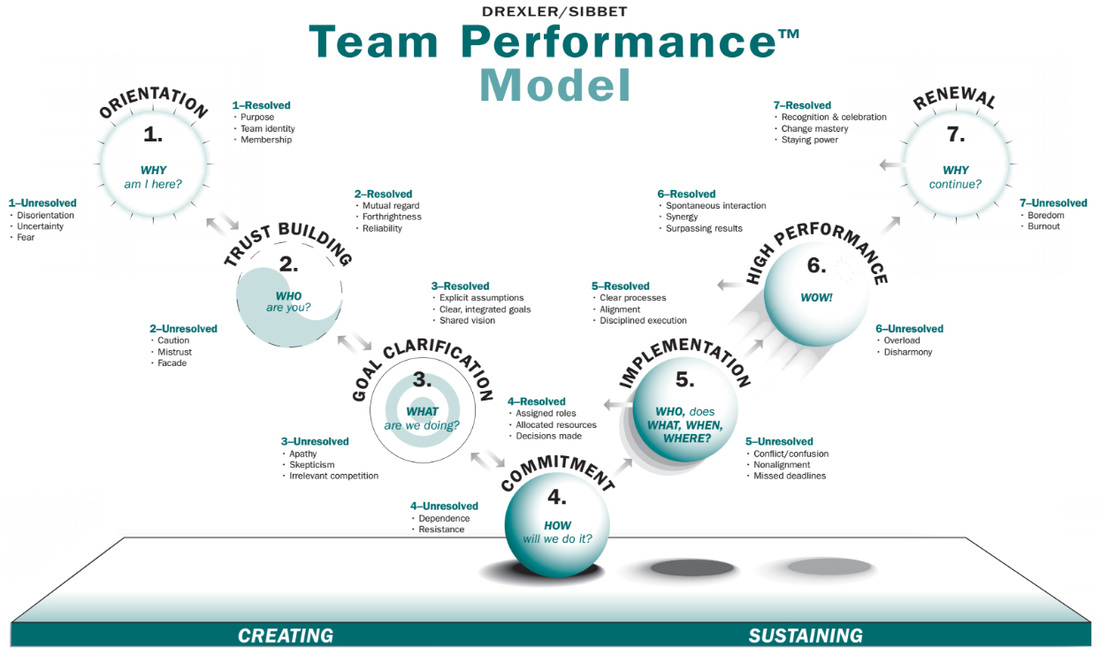
We Follow the TREXLER/SIBBET Team Performance Model
|
1. ORIENTATION
When teams are forming everybody wonders WHY they are here, what their potential fit is and whether others will accept them. People need some kind of answer to continue. |
2. TRUST BUILDING
Next, people want to know WHO they will work with— their expectations, agendas and competencies. Sharing builds trust and a free exchange among team members. |
3. GOAL CLARIFICATION
The more concrete work of the team begins with clarity about team goals, basic assumptions and vision. Terms and definitions come to the fore. WHAT are the priorities? |
4. COMMITMENT
At some point discussions need to end and decisions must be made about HOW resources, time, staff— all the bottom line constraints—will be managed. Agreed roles are key. |
|
5. IMPLEMENTATION
Teams turn the corner when they begin to sequence work and settle on WHO does WHAT, WHEN, and WHERE in action. Timing and scheduling dominate this stage. |
6. HIGH PERFORMANCE
When methods are mastered, a team can begin to change its goals and flexibly respond to the environment. The team can say, “WOW!” and surpass expectations. |
7. RENEWAL
Teams are dynamic. People get tired; members change. People wonder “WHY continue?” It’s time to harvest learning and prepare for a new cycle of action. |
Want to Learn More?
To learn more about the TREXLER/SIBBET Team Performance Model, please download and read the in-depth overview PDF.
